
Walkway grates play an important role in creating safe, dependable, and visually unified pedestrian movement across commercial buildings, public infrastructure, and industrial facilities. The right grating system supports comfortable foot traffic, consistent drainage, and long-term performance in a range of environments shaped by Australia’s climate, usage volumes, and architectural standards.
Auswave Products supplies custom stainless steel walkway grates engineered to support both the structural and aesthetic requirements of Australian projects. Each installation is produced locally, shaped to meet site demands, and designed to integrate with surrounding materials, access routes, and architectural features. Through precision fabrication, heelguard mesh patterns, and project-specific detailing, Auswave Products delivers walkway solutions that support performance, accessibility, and a strong design presence.
Why Choose Auswave Walkway Grates for Australian Projects
Walkway systems must support safe movement while also contributing to the visual consistency of the built environment. For architects, builders, landscapers, and asset owners, the right walkway solution is more than a surface. It supports circulation patterns, manages water, aligns with compliance standards, and blends seamlessly with broader design objectives.
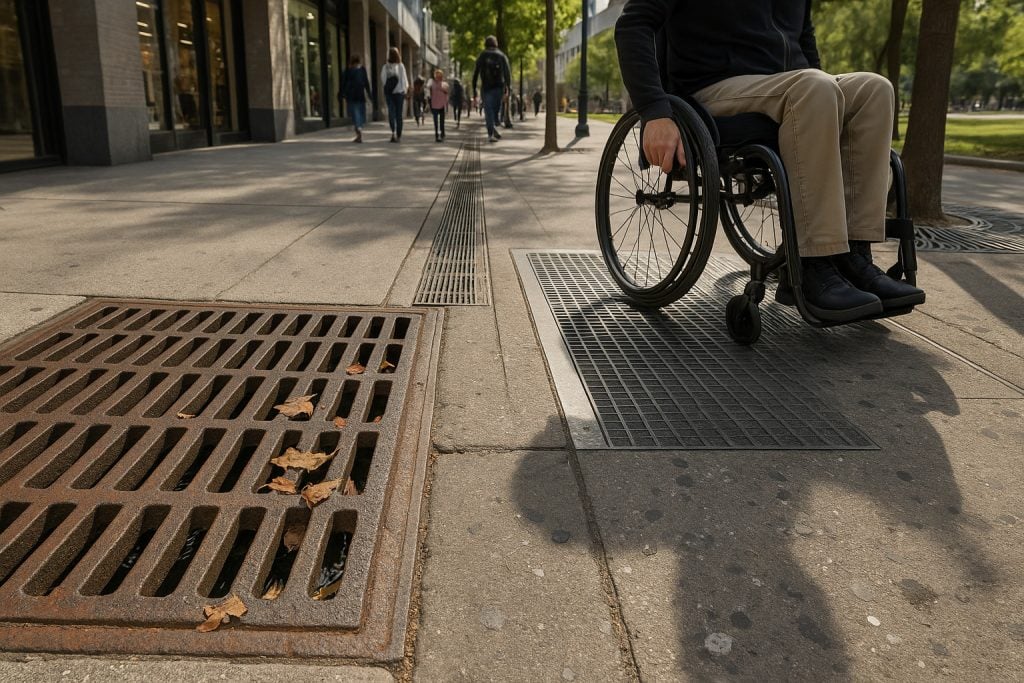
Auswave Products fabricates walkway grates that provide:
A strong architectural presence
Stainless steel grating offers a clean, precise finish suited to public realm projects, commercial precincts, civic plazas, and high-end building entries. Mesh patterns can be selected to align with adjacent materials, façade detailing, or circulation routes, allowing designers to build cohesive visual language across an entire space.
Consistent performance in diverse environments
Australian climates vary widely. Walkway grates must withstand coastal humidity, harsh sun, heavy rainfall, dust exposure, and high public use. Stainless steel performs reliably across these conditions, avoiding fading, rust, and deformation.
Flexible shaping for complex environments
Unlike off-the-shelf components, custom fabrication allows designers to follow curved paths, irregular boundaries, non-standard stair layouts, or multi-level transitions. Each panel fits the site with precision, strengthening safety while supporting design intent.
Compliance-friendly surfaces
Heelguard mesh, slip-resistant textures, and appropriately scaled openings ensure accessibility for users with varied mobility needs. Prams, wheelchairs, walking frames, and narrow heels interact smoothly with the surface, supporting predictable movement.
Efficient on-site installation
Panels fabricated to exact dimensions minimise site adjustments, reduce installation time, and support smooth delivery in busy or time-sensitive environments.
This combination of function, engineering, design integration, and project-specific fabrication positions Auswave walkway grates as a dependable solution for Australian infrastructure and architectural applications.
Where Walkway Grates Are Used Across Australia
Walkway grates serve a wide range of environments. Their versatility allows them to support heavy foot movement, specialised industrial tasks, rooftop access, and large-scale public circulation. With appropriate mesh patterns, durable materials, and tailored shapes, walkway systems contribute to safer, more manageable spaces.
Public spaces and landscape environments
In parks, plazas, waterfronts, boardwalks, and civic open spaces, walkway grates help guide pedestrian routes and manage water effectively. Open mesh patterns allow rainfall to pass through immediately, reducing slippery surfaces and avoiding water pooling. Custom shapes support curved pathways, allowing landscape architects to design with freedom while maintaining drainage performance.
Stainless steel surfaces deliver a contemporary, refined finish that complements concrete, paving, timber decking, sandstone, and softscape materials. Lighting elements, tree surrounds, and seating zones integrate neatly with mesh patterns, supporting cohesive visual outcomes.
Commercial buildings and mixed-use environments
Commercial precincts require walkways that can handle:
- High foot traffic
- Trolley loads
- Cleaning cycles
- Weather exposure
- Architectural uniformity across building entries, forecourts, and elevated walkways
Stainless steel grating suits these conditions due to its rigidity and long-term stability. Aluminium walkway grates may be used in lighter-duty rooftop access routes where weight reduction is a design priority, while FRP grating appears in the broader market for areas with repeated chemical exposure. In all cases, walkway grates help establish clear, slip-resistant movement routes.
Transport infrastructure
Transport facilities rely on walkway grates for their dependable structural properties and consistent slip resistance under heavy use. Stainless steel heelguard grates are commonly installed on:
- Station platforms
- Pedestrian overpasses
- Bus interchanges
- Access ramps
- Staff maintenance zones
- Rooftop plant platforms
Heelguard mesh prevents heels or mobility aids from becoming trapped, and stainless steel’s structure withstands continuous pedestrian flow. These qualities support the safety and efficiency expectations of high-volume transport environments.
Industrial and utility sites
Industrial settings place unique demands on walkway products. Surfaces may encounter:
- Cleaning agents
- Heat
- Moisture
- Abrasive materials
- Equipment loads
Stainless steel grates perform reliably where a rigid, corrosion-resistant surface is required. FRP grating is also used in some industrial sectors due to its chemical resistance and non-conductive qualities, but stainless steel remains preferred for environments requiring structural stiffness and low maintenance.
Rooftop access and technical areas
Multi-storey buildings require controlled, safe access to mechanical plant zones, HVAC equipment, and solar installations. Walkway grates reduce load on structural elements while preventing surface damage and supporting effective drainage. Open mesh patterns avoid water build-up and provide stable footing in exposed environments.
Across all of these applications, the ability to customise panel size, mesh density, and geometry ensures that Auswave walkway grates match the requirements of diverse Australian sites.
Material Choices: Stainless Steel, Aluminium, and FRP
Different materials behave differently under environmental stresses, load demands, and aesthetic expectations. Understanding how walkway materials perform helps specifiers choose solutions suited to their project.
Auswave Products focuses on stainless steel fabrication due to its performance, lifespan, and visual clarity. However, aluminium and FRP grating are widely used across the broader market, and it is helpful to understand how these materials compare.
Stainless steel walkway grates
Stainless steel is the preferred material for architectural, civic, and high-traffic public environments due to its combination of durability, long-term appearance retention, and structural reliability. Its passive chromium layer resists corrosion, making it well-suited for:
- Coastal sites
- Transport platforms
- Commercial forecourts
- Public plazas
- Marine-adjacent walkways
- High-use pedestrian bridges
Heelguard mesh enhances accessibility and safety by preventing heel entrapment and supporting smooth movement for mobility aids. Stainless steel maintains its form and appearance through exposure to cleaning agents, rainfall, UV light, and foot traffic over long-term service.
Aluminium walkway grates (industry comparison)
Aluminium is used in the wider industry for applications where low weight is a priority. Its characteristics include:
- Reliable performance in environments with moisture exposure
- Reduced load on supporting structures
- Efficient installation handling due to lower mass
Although aluminium is not part of Auswave’s product range, it continues to appear in rooftop walkways, light-duty access routes, and maintenance corridors in broader construction contexts.
FRP grating and FRP ramps (industry comparison)
FRP (Fibre Reinforced Plastic) grating supports environments exposed to chemicals or constant moisture. It is valued for:
- High corrosion resistance
- Non-conductive properties
- Lightweight handling
- Slip-resistant moulded textures
FRP appears in washdown areas, aquatic facilities, food production zones, and industrial settings with chemical exposure. While Auswave Products does not supply FRP, its presence in the market helps clarify why stainless steel remains the first choice for architectural projects that prioritise visual alignment, rigidity, and structural reliability.
Choosing the right material
When comparing these materials, stainless steel consistently offers the longest lifespan, strongest structural profile, and most refined visual outcome. For projects requiring design cohesion, durability, and custom fabrication, stainless steel walkway grates deliver the highest performance.
Grating Options for Diverse Walkway Requirements
Projects that involve pedestrian circulation often require a mix of surface types, and the broader market offers several options that suit different environments. A grating walkway may combine stainless steel components with alternate materials in areas that require lightweight handling or chemical resistance. In commercial settings, a steel grate provides rigidity and long-term stability, supporting predictable movement across elevated paths or busy access points. Some facilities refer to designated areas as a grating shop or shop walkway, where grate flooring helps manage water, debris, or frequent cleaning cycles.
Specialised applications may also call for materials used in the wider industry such as FRP ramps, which support movement on inclined surfaces exposed to moisture or chemicals. Ramp grating in these contexts offers slip resistance while maintaining structural shape under varied conditions. Designers can also specify grating patterns that influence drainage, traction, and the visual rhythm of a walkway, allowing the surface to complement architectural or landscape elements while supporting safe use across Australian environments.
Performance and Durability for Demanding Conditions
Australian environments expose walkway surfaces to sunlight, moisture, temperature changes, and heavy pedestrian movement. A high-quality walkway grate must resist these stresses while maintaining its function and appearance.
Auswave Products designs stainless steel walkway grates with performance longevity as a guiding principle.
Corrosion management
Stainless steel’s resistance to rust stems from its passive protective layer, which regenerates in the presence of oxygen. This allows walkway grates to maintain a consistent appearance without needing coatings or treatments. Stainless steel is suited for:
- Waterfront developments
- Coastal promenades
- Marine infrastructure
- Urban environments with pollutants
- Commercial zones exposed to cleaning agents
This reliability reduces maintenance cycles and supports predictable asset performance.
Weather resistance
Walkway grates face constant exposure to outdoor conditions. Stainless steel resists:
- UV deterioration
- Warping
- Surface fatigue
- Discolouration

Load capacity and structural stiffness
Pedestrian movement is only part of the load a walkway may experience. Trolleys, equipment, maintenance crews, and service carts all contribute to surface pressure. Stainless steel grating distributes weight evenly across its mesh patterns, preventing sagging or deformation.
Reinforced bar profiles maintain stiffness without unnecessary mass, ensuring walkway performance across:
- Shopping centres
- Transit facilities
- Commercial rooftops
- Industrial buildings
Drainage efficiency
Open mesh structures channel water directly through the walkway. This prevents pooling, supports slip resistance, and protects underlying surfaces. Efficient drainage also reduces the risk of moss, algae, or debris accumulation.
Through strong structural performance and weather resilience, stainless steel walkway grates remain dependable across long service cycles in demanding Australian environments.
Slip Resistance, Mesh Patterns, and Accessibility Standards
Slip resistance directly affects pedestrian safety and movement quality. Auswave Products designs mesh patterns that support reliable traction and comply with accessibility considerations.
Heelguard mesh for public access
Heelguard mesh provides predictable footing and prevents:
- Narrow heel entrapment
- Mobility aid disruption
- Vibration when crossing the surface
The pattern aligns with DDA-aligned opening sizes, supporting inclusive access across ramps, landings, and pathways. Heelguard mesh is widely used in plazas, transport infrastructure, commercial entries, and pedestrian bridges.
Surface texture for varied environmental conditions
Mesh patterns may include:
- Expanded mesh
- Wire mesh
- Serrated surfaces
These profiles offer:
- Grip in wet conditions
- Steady footing on inclines
- Reliable traction for varied footwear
- Consistent movement across high-traffic areas
Barrier and edge integration
Walkway grates often connect with:
- Safety barriers
- Balustrades
- Handrails
- Planting areas
- Kerbs
Consistent mesh alignment creates smooth transitions and avoids abrupt material changes. This integration strengthens both safety and visual continuity.
Modular and custom shapes
Custom shaping ensures walkway grates match:
- Curved landscapes
- Angular platforms
- Irregular landings
- Tapered staircases
- Sloped access routes
Custom panel geometry allows designers to refine circulation flow while maintaining drainage and slip performance.

Custom Fabrication and Architectural Integration
Custom fabrication is central to Auswave Products’ offering. Rather than relying on fixed dimensions, each walkway grate is tailored to site conditions and design briefs.
Tailored for complex layouts
Public spaces, commercial buildings, and civic landscapes often feature:
- Irregular boundaries
- Multi-level circulation
- Non-standard stairs
- Curved paths
- Mixed-material edges
Custom fabrication ensures each panel fits these conditions precisely, reducing trip hazards and supporting design accuracy.
CAD-supported development
Every custom grate is developed through:
- CAD modelling
- Detailed shop drawings
- Verification of as-built conditions
This ensures the final outcome aligns with real site geometry, reducing waste and minimising on-site alteration.
Design-led integration
Custom fabrication allows grates to reflect the broader architectural narrative:
- Finishes can match surrounding materials
- Mesh patterns can echo façade motifs
- Panel geometry can follow landscape forms
Walkway grates become part of the site’s identity rather than isolated components.
Installation efficiency
Panels fabricated to exact measurements support:
- Faster installation
- Reduced on-site risk
- Shorter downtime for public or commercial areas
This is especially valuable in:
- Transit environments
- Active retail precincts
- High-use commercial buildings
Sustainability and Lifecycle Value
Sustainable walkway design considers material extraction, production, installation, maintenance, and end-of-life possibilities. Stainless steel walkway grates contribute positively across these stages.
Recyclability
Stainless steel is fully recyclable and often contains recycled content. This supports circular material practices and reduces waste across large projects.
Low maintenance demands
Stainless steel requires minimal upkeep due to its corrosion resistance. This reduces:
- Chemical use
- Replacement frequency
- Transport-related emissions
- Labour requirements
Long-term structural performance
By resisting deformation, corrosion, and wear, stainless steel panels contribute to lower whole-of-life costs and reduced environmental impact.
Efficient material use
Mesh patterns deliver strength with reduced mass, contributing to resource-efficient design without compromising performance.
Through lifecycle stability and material efficiency, stainless steel walkway grates support responsible, future-oriented development.
Speak With Auswave Products About Custom Walkway Grates
Auswave Products provides Australian-fabricated stainless steel walkway grates designed to support architectural quality, structural performance, and long-term reliability. If you are planning new pedestrian routes, upgrading infrastructure, or designing circulation systems for commercial or civic spaces, our team can assist with:
- CAD drafting
- Custom fabrication
- Stainless steel mesh selection
- Advice on load ratings and finishes
- Integration with surrounding structures
To discuss your project or request drawings or a tailored quote, contact Auswave Products. Our walkway grates are designed to support safe, efficient, visually cohesive environments across Australia’s diverse conditions.

